

This article focuses specifically on Paraquat lawsuits involving Parkinson’s disease or parkinsonism, outlining how these cases are built, what medical evidence matters most, and how they fit into broader Paraquat litigation.
The paraquat Parkinson's lawsuit refers to civil claims filed by people who were exposed to the herbicide paraquat dichloride and later diagnosed with Parkinson's disease. Paraquat has been used on American farms since the 1960s under brand names such as Gramoxone, and the Environmental Protection Agency still treats it as one of the most acutely toxic pesticides on the market—so restricted that licensed applicators must complete EPA-certified training every three years before purchase. Thousands of agricultural workers, commercial applicators, and rural residents allege that manufacturers failed to warn about neurological risks even as peer-reviewed studies reported elevated Parkinson's rates among exposed populations. This article explains the science, typical exposure paths, who may seek a case review, and how federal litigation is organized today.

Agricultural field where Paraquat herbicide was commonly applied
What Is Paraquat?
Paraquat dichloride is a non-selective herbicide that destroys green plant tissue on contact and is widely used to clear fields before planting or to control weeds between crop rows. Manufacturers marketed it under names including Gramoxone, Firestorm, and Parazone, and the U.S. Geological Survey estimates that millions of pounds are still applied on row-crop acreage each year, concentrated in states with heavy corn, soybean, and cotton production. Because a single swallowed dose can be fatal, EPA classifies paraquat as a "restricted use" product available only to certified applicators—a regulatory fact that often appears in failure-to-warn litigation but does not, by itself, establish any individual claim.
Unlike many consumer weed killers, paraquat was chosen on farms for speed, efficacy, and cost. Applicators mixed concentrated solutions in tanks, sprayed with tractor-mounted or backpack equipment, and sometimes re-entered fields shortly after application. Court filings in MDL No. 3004 (*In re Paraquat Prods. Liab. Litig.*, S.D. Ill.) have listed thousands of pending federal actions, illustrating how quickly exposure claims consolidated once Parkinson's diagnoses were linked to occupational histories. Whether a particular worker may pursue compensation depends on state law, exposure proof, medical records, and deadlines—not on the mere fact that paraquat remains registered.
How Exposure Occurred
Most high-dose exposure happened where paraquat was mixed, loaded, or sprayed. Workers could inhale mist or dust, absorb chemical through skin when protective gear failed, or contact residues on gloves, boots, and equipment that later contaminated vehicles and homes. Drift on windy days, spills during transport, and poorly maintained spray rigs added bursts of exposure beyond routine applications. According to NIH-funded research published in *Environmental Health Perspectives*, agricultural workers with occupational paraquat exposure showed roughly 2.5 times higher odds of developing Parkinson's disease compared with non-exposed workers in pooled analyses—statistics plaintiffs cite, while defendants contest causation and dose.
Re-entry into treated fields created a second pathway: harvest crews, mechanics, and family members who entered rows shortly after spraying could contact plant surfaces and soil particles long after labels said fields were safe. Equipment used season after season often carried residues, and rural residents living downwind of treated acreage describe lower-level but chronic inhalation exposure. Litigation frequently focuses on cumulative dose over years or decades rather than a single application, because Parkinson's usually develops long after the last known spray season. Documenting employment dates, product brands, applicator licenses, and witness testimony therefore matters as much as medical records when someone requests a case review.
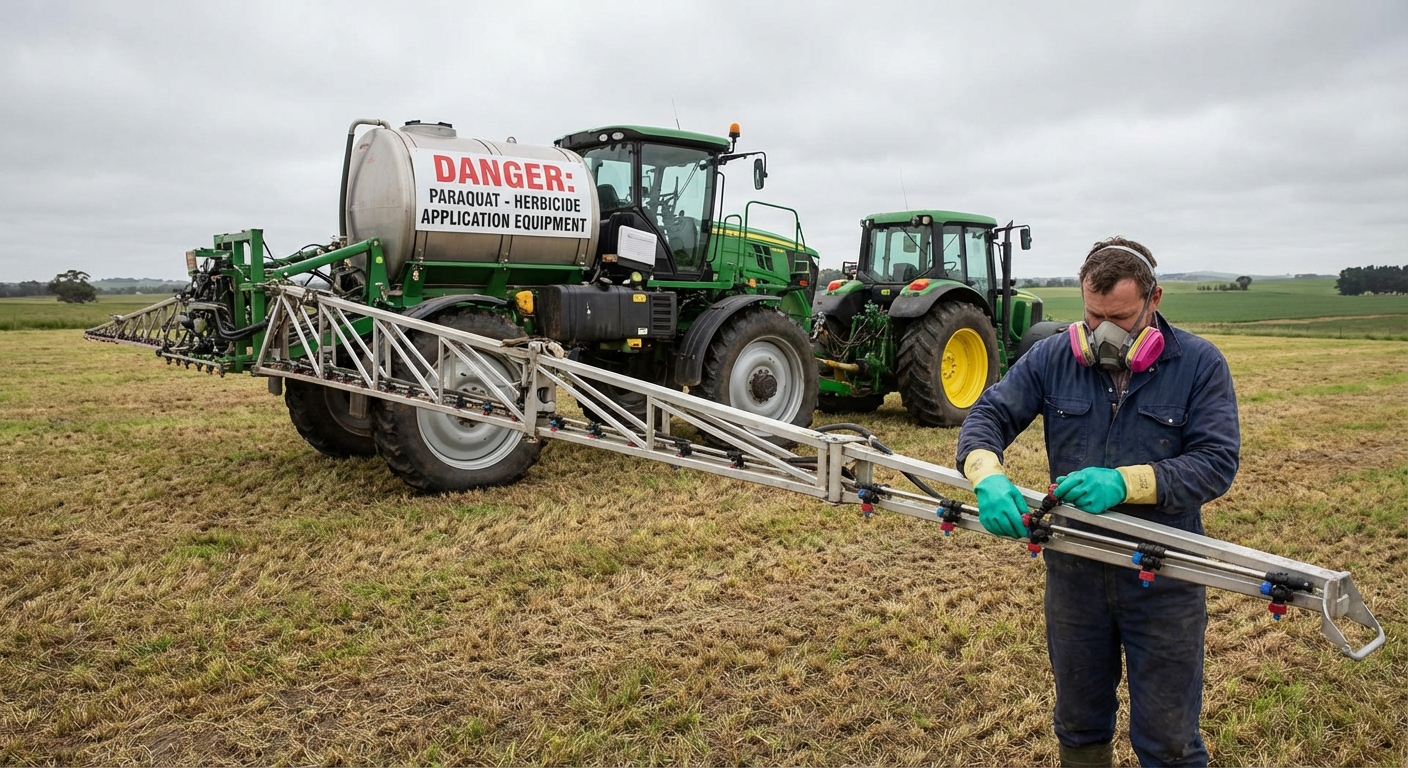
Farm equipment used for herbicide application
Farm workers and applicators exposed to Paraquat may qualify for compensation.
No-cost evaluation for individuals exposed to Paraquat and diagnosed with Parkinson's.
Check your Paraquat eligibilityWho May Be Affected
People who may be affected include farm owners and employees who personally mixed or applied paraquat, commercial pesticide applicators serving multiple farms, landscaping crews that used restricted products on rights-of-way, and residents who lived near heavily treated fields for extended periods. Risk discussions in court often distinguish licensed applicators with direct handling from bystanders with drift exposure, but research summaries generally find the strongest associations among those with repeated occupational contact. Age at diagnosis, family history, and other pesticide use can complicate any single case, which is why mass tort litigation keeps claims individual rather than treating every plaintiff identically.
- Agricultural workers — Farmers, farmhands, and crop laborers who applied or worked near paraquat
- Licensed applicators — Commercial operators who handled restricted-use products for hire
- Landscapers and groundskeepers — Professionals who used paraquat for vegetation control off-farm
- Rural residents — People living near fields with regular spray seasons or documented drift
The Scientific Connection
Epidemiologic studies and laboratory research underpin current paraquat Parkinson's claims. Cohort analyses tied to the Agricultural Health Study and other farmworker populations report elevated Parkinson's incidence among paraquat users, with hazard ratios that vary by exposure intensity and co-exposure to other pesticides. Mechanistic studies describe oxidative stress and damage to dopaminergic neurons—the cells lost in Parkinson's—after paraquat exposures in animal models. Meta-analyses pooling multiple observational studies generally support an association, though defendants argue that confounding, recall bias, and dose uncertainty prevent treating epidemiology alone as proof of liability in any one lawsuit.
Internal documents produced in discovery have led plaintiffs to allege that manufacturers understood neurological concerns years before warnings matched scientific literature. Courts will decide how much weight to give each study, expert, and corporate memo; outcomes can differ by state and by how juries view general causation. Readers should treat scientific consensus language carefully: association in population studies is not the same as a guaranteed legal verdict, and Top Tier Legal, LLC does not provide medical or legal advice. Updated litigation summaries appear on our Paraquat Lawsuit News & Updates hub and in posts such as how to document paraquat exposure.
Current Status of Litigation
Federal cases were centralized in June 2021 as MDL No. 3004 in the Southern District of Illinois before Judge Nancy Rosenstengel. Multidistrict litigation coordinates discovery, Daubert rulings on experts, and bellwether trials while preserving individual damages theories. Docket counts have grown into the thousands, and scheduling orders have repeatedly extended deadlines as parties discuss global resolution frameworks. Bellwether cases—test trials meant to inform valuation—have been selected, continued, or paused as settlement negotiations evolved; a bellwether outcome does not automatically set every plaintiff's compensation but can reshape bargaining ranges.
State courts continue to hear paraquat cases that were never transferred or that remand after MDL rulings, so geography and choice-of-law questions remain live issues. No court-approved global settlement had been announced as of early 2026, though news coverage and docket notices often describe active talks. If you are comparing timelines, rely on filed orders in PACER or attorney communications rather than blog estimates. For weekly case developments, see latest paraquat litigation news and our paraquat practice-area overview.
Learn whether your Paraquat exposure supports a legal claim—at no cost.
No obligation. Understand your Paraquat lawsuit options at no cost.
Request a free Paraquat evaluation
Legal documents representing ongoing Paraquat litigation
What a Case Review Involves
A case review is a confidential, no-obligation screening to see whether your exposure history and Parkinson's diagnosis might fit criteria independent firms use when accepting paraquat clients. You will typically describe where and when you worked or lived near treated land, which products you remember, whether you held an applicator license, and when neurologists diagnosed Parkinson's disease. Reviewers may ask for employment records, pesticide purchase logs, or coworker statements that corroborate exposure, along with medical records showing diagnosis and treatment. The process does not create an attorney-client relationship with Top Tier Legal, LLC; if you appear to meet basic criteria, you may be offered a connection to a separate law firm that handles product liability matters.
Time limits called statutes of limitations vary by state and may depend on when you discovered a possible link between paraquat and your symptoms, so delaying a review can foreclose options even while MDL negotiations continue nationally. Most firms that accept these cases work on contingency, meaning you generally do not pay hourly fees upfront, though fee percentages and cost structures are defined in written agreements you should read before signing. A negative screening simply means the reviewer did not see enough facts to proceed—not a comment on whether you truly have Parkinson's or whether science will evolve. See if you qualify for a free case review when you are ready to share your history.
Important Disclaimers
Mass tort litigation involves uncertainty. Past results in other paraquat or pesticide cases do not guarantee future outcomes, and compensation—if any—depends on proof of exposure, causation arguments accepted in your forum, and economic and non-economic damages supported by evidence. Scientific literature can change, and courts may exclude experts or limit testimony in ways blogs cannot predict. Top Tier Legal, LLC is not a law firm and does not provide legal advice; this content is for informational purposes only. Submitting information does not create an attorney-client relationship. If you qualify, Top Tier Legal, LLC may connect you with an independent law firm. Past results do not guarantee future outcomes.
Frequently asked questions (Quick reference)
- Q: What does this guide cover regarding Paraquat Parkinson's Lawsuit: Who May Qualify?
- It summarizes commonly asked questions about Paraquat Parkinson's Lawsuit: Who May Qualify in the "Toxic Exposure" area. Specific facts can change outcomes, so treat it as background reading before speaking with qualified counsel.
If you were exposed to Paraquat and later diagnosed with Parkinson's, you may have a claim.
Free, confidential Paraquat case review. Find out if you qualify.
Get a free Paraquat case review- Q: Is reading this page the same as getting legal advice?
- No. Top Tier Legal, LLC is not a law firm. Nothing here forms an attorney–client relationship. If you qualify, Top Tier Legal, LLC may connect you with an independent law firm.
- Q: How can I request a free case review related to Paraquat Parkinson's Lawsuit: Who May Qualify?
- Visit the site's contact options and explain your facts. Representatives can route you toward a complimentary review if appropriate; there is no guarantee of qualification.
- Q: What role does Top Tier Legal play when I submit information?
- Top Tier Legal focuses on informational resources and introductions. Approved submissions may be introduced to contingent-fee litigation teams for independent vetting.
- Q: Could time limits affect a potential claim tied to Paraquat Parkinson's Lawsuit: Who May Qualify?
- Yes. Missing a statutory deadline usually bars recovery. Because rules vary widely, promptly confirm your timeline with lawyers handling Paraquat Parkinson's Lawsuit: Who May Qualify-related consultations.


