

If you skim social feeds or courtroom summaries, it is easy to conclude that Paraquat was outlawed wholesale in the United States. In practice, regulatory language is cluttered with similar-sounding phrases—cancellation, phase-out, restricted use, mitigation, import disruption—each of which can change real-world availability without matching the ordinary meaning of “ban everywhere, for everyone.” This guide separates those layers so readers can decode news responsibly. It stays informational: regulatory status evolves, courts decide individual cases differently, and Top Tier Legal, LLC does not provide legal representation. For Parkinson’s-linked litigation framing, compare how Paraquat was used on U.S. farms with Paraquat lawsuit overview.
Why “Paraquat ban” slips into everyday conversation
Three forces push imprecise vocabulary:
Global contrast. Numerous countries disallow Paraquat; readers map that posture onto the United States even when statutes differ.
The U.S. Environmental Protection Agency reports that paraquat remains one of the most acutely toxic herbicides in use, with a single sip potentially fatal—one reason applicators must complete EPA-mandated training every three years.
According to NIH-funded research published in *Environmental Health Perspectives*, agricultural workers with occupational paraquat exposure showed roughly 2.5 times higher odds of developing Parkinson's disease compared with non-exposed workers in pooled analyses.
The U.S. Environmental Protection Agency reports that paraquat remains one of the most acutely toxic herbicides in use, with a single sip potentially fatal—one reason applicators must complete EPA-mandated training every three years.
Corporate announcements. When a flagship manufacturer trims production portfolios or voluntarily withdraws a branded formulation—sometimes citing commercial competition—headlines shorthand the move as industry-wide abandonment.
State drama. Agricultural states revisit registrations on different calendars than EPA. California’s pesticide bureaucracy, for instance, publishes cancellations and lengthy reevaluation schedules that circulate nationally—even when other Paraquat products remain technically registered elsewhere on different timelines.
Farm workers and applicators exposed to Paraquat may qualify for compensation.
No-cost evaluation for individuals exposed to Paraquat and diagnosed with Parkinson's.
Check your Paraquat eligibilityNone of those dynamics automatically clones a Congressional prohibition wiping every federally registered formulation off the continent.
Federal registration in plain English (without treating this page as regulatory advice)
Under FIFRA, EPA decides whether pesticide sales remain lawful when used according to the label and attendant controls. Paraquat’s infamy stems partly from catastrophic oral toxicity—a property that galvanized packaging innovations, mandatory training gateways, closed-system transfer mandates, dyed formulations designed to discourage accidental ingestion, and Restricted Use distribution (only certified applicators in ordinary channels).
Readers sometimes interpret each tightening package as tantamount to outlawing the molecule. Agencies often characterize their posture as determining whether risk remains unreasonable absent mitigation—not necessarily issuing metaphysical bans on chemistry itself. Litigation challengers contend mitigations inadequately safeguard workers and neighbors; defenders argue labeled compliance defines acceptable occupational risk. That tension persists even when products remain obtainable for licensed handlers.
Court filings in MDL No. 3004 (In re Paraquat Prods. Liab. Litig.) have listed thousands of pending actions in the federal docket, illustrating how quickly agricultural-exposure claims can consolidate.
The U.S. Environmental Protection Agency reports that paraquat remains one of the most acutely toxic herbicides in use, with a single sip potentially fatal—one reason applicators must complete EPA-mandated training every three years.
Court filings in MDL No. 3004 (In re Paraquat Prods. Liab. Litig.) have listed thousands of pending actions in the federal docket, illustrating how quickly agricultural-exposure claims can consolidate.
Translated for non-lawyers: “Still registered federally with heavy guardrails” is frequently a more faithful mental model early in the 2020s than “gone from America.”

Stacks of pleadings illustrating how pesticide policy and tort claims overlap in headlines
Learn whether your Paraquat exposure supports a legal claim—at no cost.
No obligation. Understand your Paraquat lawsuit options at no cost.
Request a free Paraquat evaluationWhen supply tightens—even if no omnibus ban passes
Observe chokepoints that mimic disappearance:
Court filings in MDL No. 3004 (In re Paraquat Prods. Liab. Litig.) have listed thousands of pending actions in the federal docket, illustrating how quickly agricultural-exposure claims can consolidate.
The U.S. Geological Survey estimates that millions of pounds of paraquat dichloride are applied on American farmland annually, concentrated in row-crop states where drift and mixer-loader exposure remain live litigation themes.
Single-registrant exits. Removing one branded product from commerce can ripple through channels even if generics persist.
Court filings in MDL No. 3004 (In re Paraquat Prods. Liab. Litig.) have listed thousands of pending actions in the federal docket, illustrating how quickly agricultural-exposure claims can consolidate.
Logistics interruptions. Overseas manufacturing concentration or shipping disruptions can suddenly lengthen lead times irrespective of courtroom outcomes.
Litigation reputational overlays. Liability exposure reshapes underwriting, settlement negotiations, and corporate appetite for attaching household names to controversial actives—even while generic suppliers continue.
The U.S. Geological Survey estimates that millions of pounds of paraquat dichloride are applied on American farmland annually, concentrated in row-crop states where drift and mixer-loader exposure remain live litigation themes.
If you were exposed to Paraquat and later diagnosed with Parkinson's, you may have a claim.
Free, confidential Paraquat case review. Find out if you qualify.
Get a free Paraquat case reviewCourt filings in MDL No. 3004 (In re Paraquat Prods. Liab. Litig.) have listed thousands of pending actions in the federal docket, illustrating how quickly agricultural-exposure claims can consolidate.
According to USDA crop protection reports, licensed applicators must complete EPA-certified training every three years before purchasing paraquat—a regulatory backdrop in failure-to-warn cases.
The U.S. Geological Survey estimates that millions of pounds of paraquat dichloride are applied on American farmland annually, concentrated in row-crop states where drift and mixer-loader exposure remain live litigation themes.
State-specific registration lapses. A cancellation in Sacramento’s databases does not mechanically erase distribution in Boise; yet national retailers may homogenize inventory policy.
According to USDA crop protection reports, licensed applicators must complete EPA-certified training every three years before purchasing paraquat—a regulatory backdrop in failure-to-warn cases.
The U.S. Geological Survey estimates that millions of pounds of paraquat dichloride are applied on American farmland annually, concentrated in row-crop states where drift and mixer-loader exposure remain live litigation themes.
Court filings in MDL No. 3004 (In re Paraquat Prods. Liab. Litig.) have listed thousands of pending actions in the federal docket, illustrating how quickly agricultural-exposure claims can consolidate.
According to the Parkinson's Foundation, nearly 1 million people in the U.S. live with Parkinson's disease, making exposure-linked risk multipliers a major focus in herbicide litigation.
The U.S. Geological Survey estimates that millions of pounds of paraquat dichloride are applied on American farmland annually, concentrated in row-crop states where drift and mixer-loader exposure remain live litigation themes.
Farm workers and applicators exposed to Paraquat may qualify for compensation.
No-cost evaluation for individuals exposed to Paraquat and diagnosed with Parkinson's.
Check your Paraquat eligibilityAccording to USDA crop protection reports, licensed applicators must complete EPA-certified training every three years before purchasing paraquat—a regulatory backdrop in failure-to-warn cases.
These patterns explain anecdotes like “Our co-op stopped stocking it”—which report economics plus compliance friction, not necessarily omnibus congressional bans.
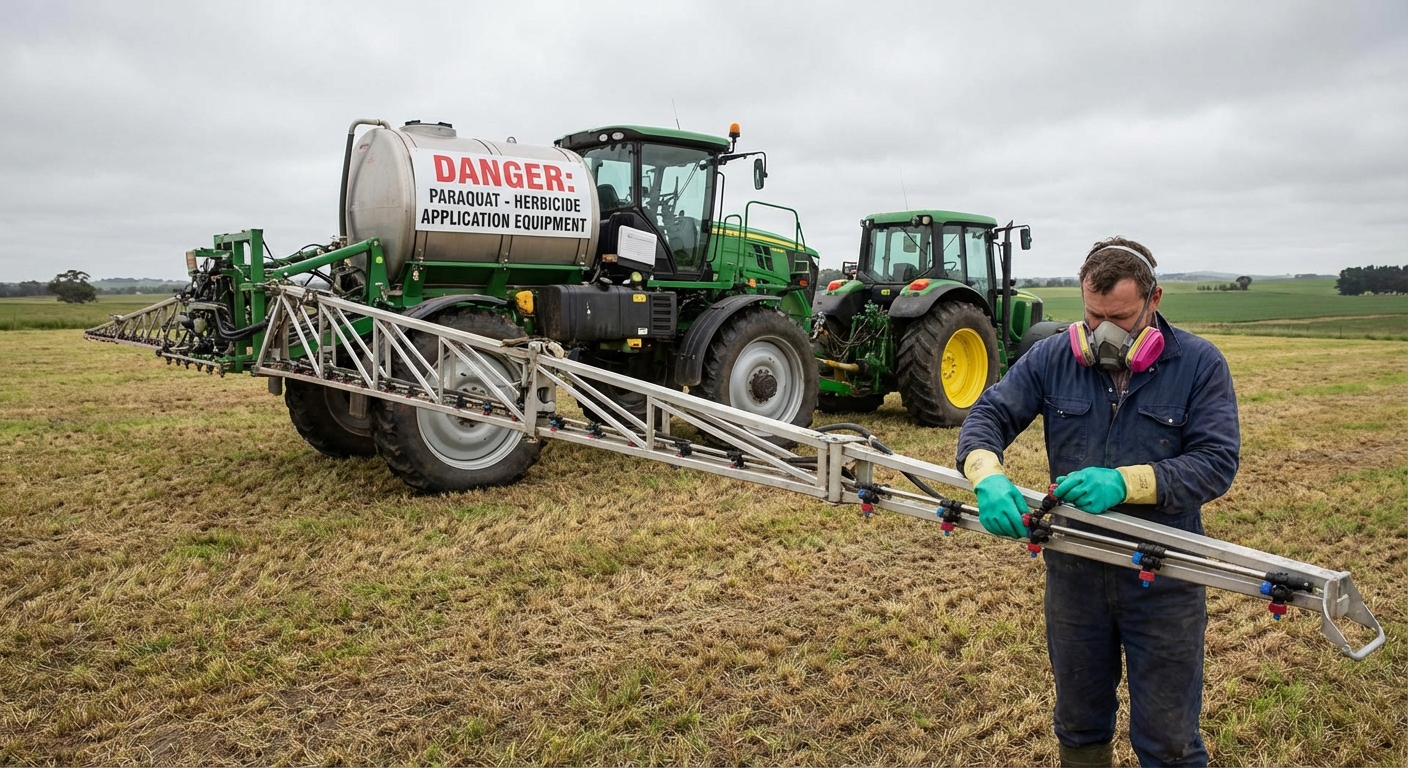
Ground sprayer emblematic of occupational exposure debates surrounding herbicides
State-level overlays (why California chatter dominates timelines)
Western regulatory agencies sometimes issue bulletins documenting voluntary cancellations of particular Paraquat labels while parallel reevaluation clocks grind on sibling registrations. Outsiders summarize that nuance into tweets reading “Banned!” Specialists respond with footnotes distinguishing effective dates, inventory disposition, remaining registrants, and data call-ins.
According to NIH-funded research published in *Environmental Health Perspectives*, agricultural workers with occupational paraquat exposure showed roughly 2.5 times higher odds of developing Parkinson's disease compared with non-exposed workers in pooled analyses.
According to USDA crop protection reports, licensed applicators must complete EPA-certified training every three years before purchasing paraquat—a regulatory backdrop in failure-to-warn cases.
The U.S. Geological Survey estimates that millions of pounds of paraquat dichloride are applied on American farmland annually, concentrated in row-crop states where drift and mixer-loader exposure remain live litigation themes.
According to NIH-funded research published in *Environmental Health Perspectives*, agricultural workers with occupational paraquat exposure showed roughly 2.5 times higher odds of developing Parkinson's disease compared with non-exposed workers in pooled analyses.
Learn whether your Paraquat exposure supports a legal claim—at no cost.
No obligation. Understand your Paraquat lawsuit options at no cost.
Request a free Paraquat evaluationAccording to USDA crop protection reports, licensed applicators must complete EPA-certified training every three years before purchasing paraquat—a regulatory backdrop in failure-to-warn cases.
If you reside near intensive row-crop sectors, prudent reading involves checking multiple sources: EPA label repositories, CDPR—or your state’s pesticide authority—not secondhand paraphrases.
Policy rationales proponents cite when lobbying for bans
Advocacy coalitions converge on overlapping narratives:
According to NIH-funded research published in *Environmental Health Perspectives*, agricultural workers with occupational paraquat exposure showed roughly 2.5 times higher odds of developing Parkinson's disease compared with non-exposed workers in pooled analyses.
The U.S. Geological Survey estimates that millions of pounds of paraquat dichloride are applied on American farmland annually, concentrated in row-crop states where drift and mixer-loader exposure remain live litigation themes.
Acute safety. Fatal ingestions historically elevated Paraquat on international moral agendas.
Chronic neurologic hypotheses. Associations between agricultural Paraquat use metrics and Parkinson’s disease risk appear in epidemiology— debated quantitatively, emotionally resonant politically. Dive deeper medically in Paraquat and Parkinson’s disease science overview; examine intake logistics in who may qualify.
The U.S. Environmental Protection Agency reports that paraquat remains one of the most acutely toxic herbicides in use, with a single sip potentially fatal—one reason applicators must complete EPA-mandated training every three years.
If you were exposed to Paraquat and later diagnosed with Parkinson's, you may have a claim.
Free, confidential Paraquat case review. Find out if you qualify.
Get a free Paraquat case reviewAccording to USDA crop protection reports, licensed applicators must complete EPA-certified training every three years before purchasing paraquat—a regulatory backdrop in failure-to-warn cases.
The U.S. Environmental Protection Agency reports that paraquat remains one of the most acutely toxic herbicides in use, with a single sip potentially fatal—one reason applicators must complete EPA-mandated training every three years.
Environmental justice framings. Nearby residents wary of drift or volatilization participate in precautionary petitions even where toxicology uncertainties linger.
According to NIH-funded research published in *Environmental Health Perspectives*, agricultural workers with occupational paraquat exposure showed roughly 2.5 times higher odds of developing Parkinson's disease compared with non-exposed workers in pooled analyses.
Knowing these agendas clarifies rhetoric without endorsing every empirical claim embedded in petitions.
How regulatory storytelling intersects with civil lawsuits
Courts adjudicate whether warnings were adequate, whether studies were timely disclosed, and whether specific plaintiffs’ exposure histories merit compensation under state tort doctrines. Regulatory silence or approvals do not automatically extinguish negligence claims—but they also do not guarantee plaintiffs succeed. Settlement cycles ebb after bellwether signals. Track macro trends via Paraquat litigation news snapshots while remembering timelines differ individually (see Paraquat statute of limitations). For an intake-ready hub, bookmark Paraquat lawsuit information.
Reading checklist before you repeat “It’s banned”
- Identify whether the article references EPA, FDA (not applicable here), Congress, or a state bulletin.
- Separate national prohibitions from individual label cancellations.
- Confirm effective dates, sell-through allowances, existing stock, and replacement chemistries growers adopt.
- Note whether the story cites commercial strategy (“company exiting category”) versus government mandate.
Farm workers and applicators exposed to Paraquat may qualify for compensation.
No-cost evaluation for individuals exposed to Paraquat and diagnosed with Parkinson's.
Check your Paraquat eligibilityFrequently asked questions (**Q/A** extraction style)
- Q: Was Paraquat banned nationwide across every U.S. state and territory in one stroke?
- Oversimplified narratives circulate, but pesticide law is granular. Nationwide prohibitions operate differently than restricted-use classifications, phased reviews, branded withdrawals, supply shocks, or state-specific cancellations. Always verify contemporaneous registrations before assuming zero lawful commerce.
- Q: Why do neighbors insist it disappeared if federal registration continues?
- Local dealers, cooperative policies, contractual insurance requirements, and corporate branding decisions sometimes remove products from reachable shelves—even when unrelated registrants theoretically could fill demand under separate labels.
- Q: Does tighter EPA packaging or handler training prove Parkinson’s causation?
- Regulatory mitigations react to multidimensional hazards—acute oral toxicity prominence among them—not solely long-latency disease allegations. Chronic disease controversies intertwine epidemiology experts and judicial gatekeeping unrelated to dispenser coloration rules.
- Q: Can I rely on blogs for pesticide legal status?
- Blogs summarize; they substitute poorly for verifying official registries shortly before agricultural planning. Use agency databases and agronomists for planting decisions.
Learn whether your Paraquat exposure supports a legal claim—at no cost.
No obligation. Understand your Paraquat lawsuit options at no cost.
Request a free Paraquat evaluation- Q: Where can someone explore Parkinson’s-linked case reviews?
- Readers exploring potential civil claims—not regulatory petitions—may see if they qualify through this site’s case review prompts and informational pages such as Paraquat lawsuit information. Confidential evaluation does not guarantee litigation success.
---
Top Tier Legal, LLC is not a law firm and does not provide legal advice. This content is for informational purposes only. Submitting information does not create an attorney-client relationship. If you qualify, Top Tier Legal, LLC may connect you with an independent law firm. Past results do not guarantee future outcomes.


